
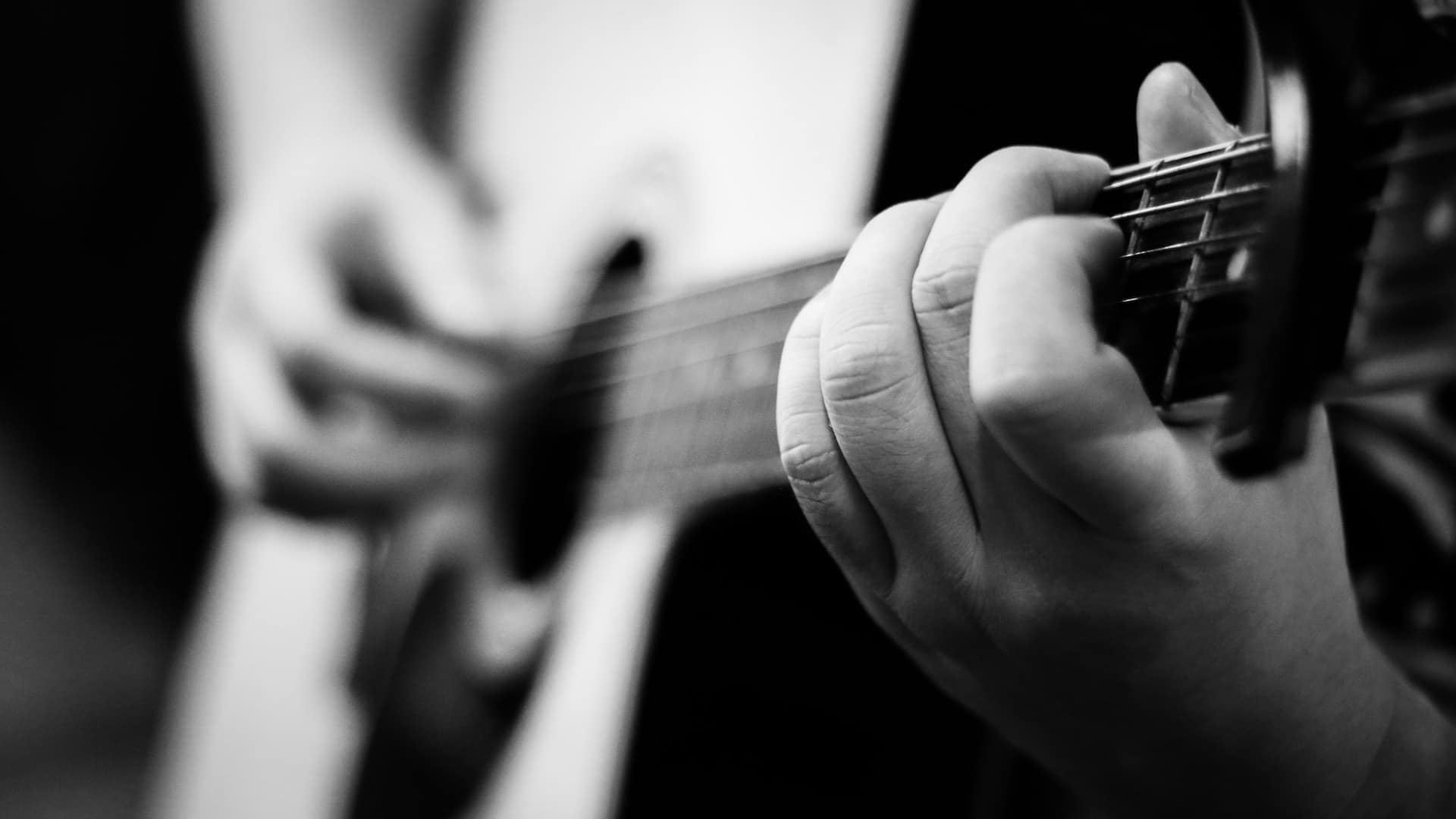
Have you ever heard things like “you have excellent hands for piano/guitar,” said to people with large hands? Do you feel you don’t fit in this category? Don’t worry! In this article, you will discover that playing guitar with small hands doesn’t have to be an issue at all. Follow these useful tips to become the best guitar player you can be, no matter your hand size!
Play songs that make you feel confident first
Everybody talks about how technique, skill, and even your gear are important, but… What about confidence? Your mindset is a huge component of playing the guitar. We tend to make more mistakes and struggle more when we’re too self-conscious and zero in too much on our playing details. We should be able to pay attention to what we’re doing while allowing us to rely on our muscle memory. These are some things you can do to achieve that state:
- Play in front of a mirror. Try focusing on yourself and stop looking down on your guitar too much.
- Gather round with your friends and play among them. Singing or playing with friends makes playing easier when you take the leap!
- Choose songs that make you feel happy, or that are easy enough for you not to pay too much attention when playing.
Remember: You’re not alone
When you feel discouraged because big names like Paul Gilbert and Eric Clapton have rather privileged hands to play guitar, remember that we also have some guitar heroes with small hands, such as Steve Vai and Jimi Hendrix!
Find the right size of guitar for you
Sometimes all it takes to play better right away is getting the right gear. If your hands are very small, there’s no shame in buying a smaller guitar. Their sound is identical to full-sized guitars, and it will ease things up. Some seasoned players will find comfortable and even prefer playing in 3/4 and 7/8-sized guitars, much like what happens with double-bass, to which orchestra players use full-sized instruments. Outside of this context, the standard player will choose the 3/4 version. You can read a quick guide by height and age in the article about teaching children to play guitar.
Check your guitar’s action
This is something any guitarist should do, regardless of their hand size. By ‘action,’ I don’t mean all the cool things your guitar can do! Action is the term used for the distance between the bottom of your strings and the top of your frets. This distance might seem fixed, but it’s entirely customizable. How high or low you want to go depends entirely on your preference. For example, country and ensemble guitarists use heavier strings. They prefer to have guitars with high action to be able to strum them hard with ease.
However, a guitar with high action can be cumbersome to a guitarist with small hands, because more strength needs to be applied to the strings to press them against the fretboard. This can make barre chords seem nightmarish and even mess up your tone due to the excess strength bending the string in uncontrollable ways. I’ve had that happen to a friend of mine. As a beginner, he was feeling very discouraged because he found that everything was too hard to do in his guitar. When he handed me said guitar to check it out, I immediately noticed his action was way too high! We immediately went to the nearest guitar store. Most clerks in charge of guitars can adjust the action for you for a small fee.
What you’re looking for, if you’re playing guitar with small hands, is a guitar with low action. It can help you relieve a lot of the strength you need for fretting, which can translate into more playing speed with diligent practice. However, make sure the action is not too low since it can cause your string to clash with other frets if your picking hand is too heavy. This noise is called ‘fret buzz’.
Take advantage of your wrists!
Most people, when learning guitar, are taught to keep their wrists and thumbs at a certain level, and this is a healthy practice. However, it also is a half-truth: placing your thumb behind your guitar’s neck provides you extra stability and reach, but moving your wrist and thumb from time to time can give you irreplaceable mobility. See how Paul Gilbert explain how wrists provide you with something that long fingers can’t in this video:
Stretch those fingers!
You can increase your reach in the fretboard by adding simple stretches into speed exercises. For instance, you can take a simple exercise that looks like this (click here for how to read tabs):

And add a small stretch like so:

Remember, no cheating! Use a different finger for each fret. Trust me, that single fret stretch between your index and middle fingers is something you will feel in your entire hand. You can play with this exercise and switch the ‘stretch’ to between your middle and ring fingers, for example.
There’s another, rather controversial way to stretch your fingers: some guitarists, especially old-school ones, will tell you to place either your wrist or the neck of your guitar between the fingers of your fretting hand to use them as some sort of stretching tool. From personal experience, though, I haven’t felt significant changes from doing that consistently. I can see the benefit of that half-exercise, half-torture to become accustomed to the discomfort having your fingers fully outstretched can produce. However, I’d rather stretch my fingers through exercises and natural playing. Quick tip inside a tip: increasing your collagen intake has been clinically proven to help with skin and joint elasticity, so… eating jelly can help you play better? Who knew!
Find notes across the strings instead
If you do your stretching exercises religiously but still feel you lack the speed to attack big gaps in the fretboard, try to find the equivalent of the note you’re trying to reach in the next string. For example, if you’re struggling with something like this:
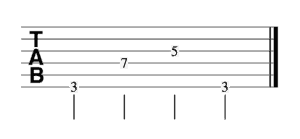
You can find the same notes from the D and G strings in a more comfortable group, using the G and B strings.
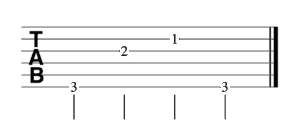
Doing small changes like this one is quite achievable in most song arrangements. The idea is to group notes and strings in a way that feels most natural and comfortable for you.
On second thought… Enjoy high frets!
Guitarists with large hands and long fingers tend to feel like they’re lacking space to move comfortably after the 10th fret mark or so. Unlike people with small, thin fingers who will be able to exploit the unique feel that playing near the bridge can give.