

Strumming is an essential component of many guitar songs, but that doesn’t mean that you’re limited to using a pick. Picks are a useful tool in the guitar world, but they tend to force a guitarist to play in a certain way. It’s almost impossible to strum without moving your entire arm, which generates plenty of power but offers little subtlety.
Strumming without a pick can increase your playing range and allow you to adjust your strumming style to a particular song. Learning a variety of techniques can open up completely new styles of how to strum a guitar, making you a better and more well-rounded player.
If you’re new to guitar playing, you may find that holding a pick is awkward enough, let alone trying to figure out how to strum correctly. Luckily, there are several other options available that you may find more comfortable for your style.
By learning how to strum a guitar without a pick, you can also improve your pick strumming at the same time. As you play, you’ll get a deeper understanding of what the pick does to a guitar’s tone and how you can use that to your advantage.
That doesn’t mean you should ignore learning how to strum a guitar with a pick as well. Instead, view these non-pick strumming techniques as another tool in your strumming arsenal. You’ll find them especially useful when you lose your pick during a jam session, which happens more often than most guitar players would like to admit.
Thumb Strumming
There are two different ways to use your thumb while strumming. Both have their advantages and disadvantages, making them suitable for a particular style of music.
The first thumb technique is to put your index finger and thumb together as if you’re holding a pick, ensuring the two fingers are in line with each other. You’ll hit the strings with your index fingernail on the way down, and your thumbnail on the up-strum.
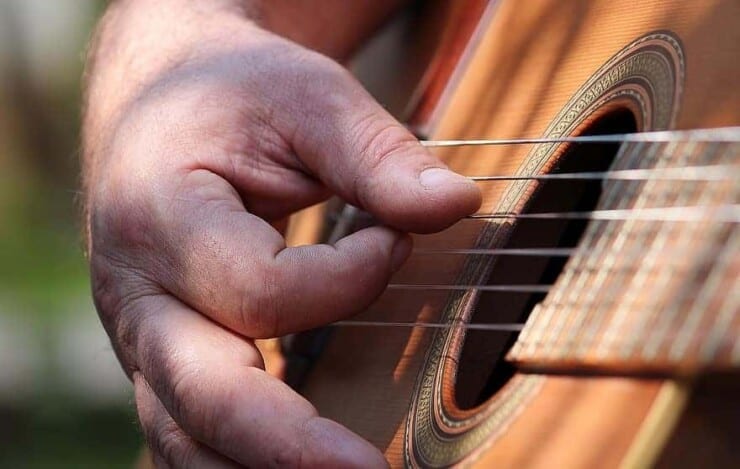
Using this thumb strumming method will produce a similar sound to using a pick since you’re hitting the strings with the hard part of your nail. If you want to create a softer sound, you can try out the second strum method.
The second method of thumb strumming is to use your thumb without bringing the index finger into the mix. In this method of strumming, you use the fleshy part of your thumb on the down strum and your nail on the upward strum.
The main disadvantage of this particular strum technique is that you get varying tones and volumes. Hitting the string with the fleshy part of your thumb produces a softer, more rounded sound, while hitting the strings with your nail produces a similar sound to using a pick.
You’re going to have to practice a bit to get an even sound on both the upward and downward motions, so don’t be afraid to change up your hand or thumb position. You can also rotate your thumb for the upward strum without hitting your nail for an overall softer tone.
If it’s your first time strumming without a pick, you can make the transition to thumb strumming easier by strumming from your elbow. You can also hold your hand still on the guitar and use your thumb independently of your arm.
If you’re anchoring your hand, make sure that you’re rotating your entire arm instead of moving your wrist up and down when strumming. Many hand injuries come from repetitive motions that damage the joint, so avoid them by learning how to strum a guitar without a pick correctly.
Each method of thumb strumming without a pick will produce a different sound and tonal range. Take your time and experiment to find out which combination of styles works best for you.
Strumming with Your Index Finger
Strumming with your index finger follows pretty much the same principle as thumb strumming, just in reverse. You get a soft sound on the upward strum and a harder, brighter sound on the downward strum.
As with thumb strumming, you can also adjust your finger position to hit the strings with the fleshy part on both the up and down strum. Doing so results in a much softer, gentler sound that’s perfect for more intimate songs.
Once you’ve got this method for strumming without a pick mastered, you can try a basic fingerstyle strum. This method involves using the fingernails of your first three fingers on the downward strum and then the flesh of your index finger on the up strum.
As with many other strumming techniques, fingerstyle strumming requires that you get a feel for the guitar. Your fingers should feel like they’re gliding over the strings, which means keeping your hand relaxed.
Strumming Like You’re Holding a Pick
If you’re used to holding a pick, this next method for strumming a guitar without a pick will feel quite natural. You start by arranging your thumb and index finger like you’re holding a guitar pick and then slightly extending your index finger forward over your thumb. Ideally, your other fingers are tucked in under your palm to avoid accidentally hitting the strings.
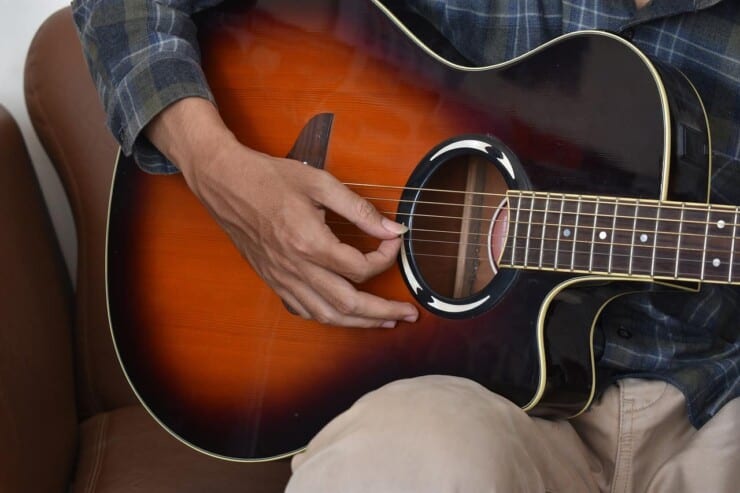
When you use this method to strum, your fingernails will hit the strings on both the up and down strums, which results in a sound very similar to a pick. If you’ve got to play guitar without a pick, but still want the same sound, this is an excellent option.
Also, just like strumming with a pick, this method allows you to play from your elbow, which can feel natural if you’ve learned how to strum a guitar with a pick. As with many of the techniques we’ve discussed, there is no one perfect way to play. Take the time to find the right set up and play style that works for you.
Mixing it Up
Once you’ve mastered how to strum a guitar without a pick with the methods we’ve described, why not mix it up a bit? Each strum pattern and technique produces a different sound and tone, and learning how to strum a guitar without a pick can open up new creative ideas and help you establish a new signature sound.
Play around with the techniques you’ve learned. Try playing single bass notes with your thumb and then strumming using your index finger. Try more advanced techniques, both with and without a pick, to find out which one you prefer.
While guitar playing does have a certain level of skill mastery, it’s also a personal and creative venture. Don’t be afraid to experiment with how to strum a guitar without a pick. No matter what you do, you’re going to make mistakes; focus on having fun while learning a new strumming pattern using your fingers.
Most players perform at their best when they’re comfortable. Instead of worrying about finding one method that may be awkward to play, try to make your own strumming style. Not only will you play better, but you’ll also learn new techniques to play around with and will gain more experience.
Flamenco Strumming
Once you’re comfortable with at least one of the methods of how to strum a guitar without a pick, you can move onto more advanced techniques, such as those used in a flamenco guitar.
Many novice guitarists shy away from flamenco guitar, thinking that it’s incredibly difficult and technical. While this isn’t entirely false, the truth is that even learning one flamenco pattern will add a whole new dimension to your playing.
The basic flamenco pattern is the rumba flamenca rhythm. This pattern involves strumming down with the full hand, strumming up with the thumb, and progressing into a slightly more complicated pattern using the index finger for strumming while keeping the thumb on the topmost string.
Flamenco strumming is definitely beyond the scope of just an alternative method for strumming without a pick, but it’s a useful skill to have. If you’re interested in taking your strumming up one level, give flamenco strumming a try.
Conclusion
There’s a time in every guitar player’s life when you’re going to want to play a song only to find you don’t have a pick. Instead of cutting up old credit cards or hunting down any remotely viable piece of plastic, why not learn how to strum without a pick?
Strumming with your fingers opens up a completely new world of possibilities, such as generating a rounder sound by using the fleshy parts of your fingers or thumb.
Some people find they have better control using finger strumming and picking techniques. Once you’ve passed the basics of chord strumming, you’ll discover that learning various strum patterns requires you to skip certain strings. Many people find that they hold their pick so close to the tip that they may as well use their thumb or fingers instead.
Playing without using a pick requires just as much practice as learning to play with one. Don’t be afraid of making mistakes when you first start, since often that’s the best way to learn. Once you’re comfortable with the finger strumming basics, why not check out more advanced techniques that will take your playing to the next level?