
Are you creating your own pedalboard, but aren’t sure about how to power your pedalboard? If so, then you’re not alone. This is something many guitarists go through, especially beginners.
Powering pedalboards the correct way is as important as any other step involved with creating the pedalboard. To power the pedalboard, you’ll need to know the different power outlet options and choose one that best suits your pedalboard.
In this article, you’ll get to know all about how to power pedalboard, the basics of voltage, current, and polarity, the types of power sources, how to choose the right power outlet, and more. Continue reading to get all the answers you’re looking for.
Get started with how to power pedalboard
As a guitarist, you’d probably spend a lot of time and effort amassing the right pedals and the right combination. The final hurdle would be to make them work together. Powering them will be an important deal. If you’ve only got one or two pedals, it’ll be easy to use batteries or individual power supplies. Some pedals even come with power supply outlets included. If you’ve got more than that, you will likely want a more cohesive system. It’s even more imperative if there are a lot of pedals and the pedalboard needs to be mobile.
A pedalboard power supply is essentially a single source supply for powering all the pedals. These power supplies will come in different configurations for accommodating your needs. If you’re looking to get started with guitar pedals, you’ll want to know how to power pedalboard. There are different types of guitar pedals and not all of them are the same when powering them. Continue reading to know more about how to power the different pedals on your pedalboard.
Basics of powering your pedalboard – Voltage, current, and polarity
Before looking at the different types of power supplies, it’s important to look at the basics of powering the pedalboard. Voltage, current, and polarity are important concepts for powering the pedalboard. To know how to power pedalboard, you’ll need to get these things right. You’ll need to go through each one of them, as it’ll tell you how to power your guitar pedals.
Voltage
Voltage is used for measuring the potential energy in a circuit. If you’re a guitarist, you’ll want to know that you should match the voltage (V) of the pedal to the power supply you’re using. Most guitar pedals need 9V power (even most multi-effects pedalboards). If you have a guitar pedal that has 9V mentioned on it, ensure that you’re using a 9V power supply.
You should remember that while many guitar pedals use 9V, there are some out there that need a higher voltage. If you’ve got a pedal that runs on 12V, 18V, or 24V, ensure that the power supply you’re using matches the voltage. Some guitar pedals are versatile and accept a wide range of voltages. For instance, the Fulltone OCD will allow you to connect any voltage from 9V to 18V.
A key point to remember is that the voltage the pedals accept should match the voltage the power supply delivers. This is significant as the wrong voltage to the guitar pedal can potentially damage the pedals.
Current
You can think of current as the flow of electricity in the circuit. A high current will mean a lot of electricity is flowing in the circuit. A circuit is usually measured in Amps (A). Most guitar pedals can only draw a limited amount of current. For instance, you may see the label “100mA” on the back of the guitar pedal. This means that the pedal is drawing 100 milliamps of power, with a milliamp being one-thousandth of an amp.
When matching the power supply to the guitar pedal, the current requirements will be different from the voltage requirements. With voltage, you’ll have to match the voltage (i.e. 9V power with a 9V pedal). With current, you should ensure that the power supply has enough current. If the guitar pedal is drawing 200mA of power, you’ll have to use a power supply that is providing at least 200mA of power.
If the power supply happens to be lower than the pedal’s requirements (i.e. 100mA power supply with a 200mA pedal), it won’t be enough. You may even burn out the power supply if you try connecting it to the power. If the power supply is matching the current requirements (i.e. 200mA power supply on 200mA pedals), then you’ll be able to use it as long as you’re not trying to daisy chain more pedals.
In case the power supply has a higher current rating compared to the pedal (i.e. 500mA power supply with 200mA pedals), it’ll be perfectly fine to use. You can also use the power supply to daisy chain more pedals. The current value of the power supply will be the maximum current that the power supply can potentially provide. You won’t have any problem connecting 100mA pedals to a 1000mA power supply. This is the case as the pedal will only be drawing 100mA of power.
An important point worth remembering is that the power supply you’re using must offer at least the same current as what the guitar pedal needs. It’ll be fine if the power supply’s current rating is considerably higher than the pedal’s current requirements. It won’t be an issue as the pedal only draws as much as it needs.
Polarity
Polarity is essentially the technical term to denote positive and negative. When you’re connecting a power supply to the pedals, you should ensure that the positive and negative connections properly match. You’ll be able to see the polarity of the power jack on pedals with the symbols mentioned next to it. The symbols will show whether the top of the jack is positive (+) or negative (-). This will as important detail as plugging the wrong power source into the guitar pedals could fry them. The power jack will provide power using the pin and sleeve.
Most pedals tend to have a negative center pin so that you’re able to see the pedal’s negative polarity symbol. All you’ll need is to ensure that the external power supply is also using a negative center pin, and you’ll be good to go.
If you’re having a power adapter with you, you can check whether it’s using a negative or positive center pin. You can do it by looking for the same symbol on the power adapter. You’ll be able to see if your power adapter uses a negative or positive center pin. A negative center pin means that it’ll be compatible with most pedals.
However, you’ll still need to check the voltage and current before plugging the pedal in. For instance, say that the power supply delivers 9V to the pedal, and it has a maximum current of 300mA. With this information, you’ll be able to figure out whether the power supply is compatible with your pedals or not.
It’s important to remember that the polarity of the power supply needs to match the polarity of the pedals. Connecting a power supply to the wrong polarity can end up damaging the gear.
Different types of external power supplies
How will you know how to power your pedalboard if you don’t know the different power supply options? Here are the different types of power supplies that you can use with your pedalboard.
Basic DC Adaptor
The first one will be a Basic DC Adaptor. Many pedals come with this type of adaptor, which allows you to start using the pedals straight away. These adaptors will be great for simple pedalboards or even DIY pedalboards. If you’re using one or two pedals, this will be the perfect choice for powering them. If you’re using 3-5 pedals, you’ll need to use a DC adaptor that can power all the pedals using daisy-chaining.
Daisy chaining is an easy way of connecting multiple pedals to one power source. These power supplies will be relatively cheap, compact, and simple to use, especially when you have a few pedals. If you’re working on a decent-sized pedalboard, you can use a few of them to power all the pedals. However, there is a far better option that you’ll want to consider.
Dedicated Power Supply
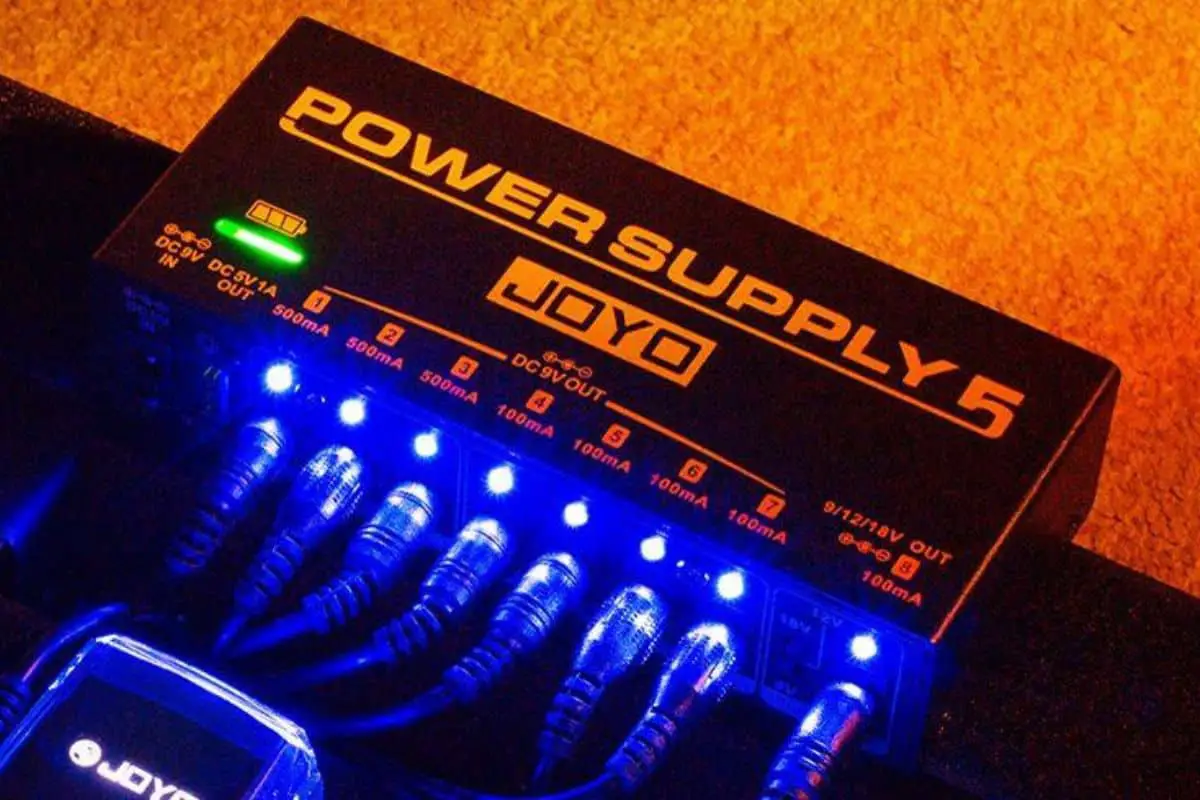
The second type of power supply and the superior option is a Dedicated Power Supply. These large, brick-shaped power supplies are specifically designed for guitarists who are working on a large pedalboard. They’re perfect for people who require different pedal requirements for different pedals.
Instead of just daisy chaining all the pedals together using an adaptor, you can plug all the pedals directly into the dedicated power supply. The advantage of using a dedicated power supply will be the isolated connections. When you’re daisy-chaining pedals together, every pedal’s circuits will be connected to each other. This can easily be an issue.
It can cause issues as some pedal circuits tend to be “dirtier” than others, such as vintage fuzz pedals. Connecting pedals with the same non-isolated power supply could also cause noise in the tone. You may hear a slight buzzing, humming, or random noises in the background of the tone.
However, this isn’t the case with isolated power supplies. The isolated power supplies will prevent this, as each connection will be completely separate from the other. You’ll be able to connect a vintage fuzz pedal to the isolated power supply without any problems with the signal.
Use external batteries with the guitar pedals
While power supplies do have many advantages, some guitarists simply don’t need them at all. You could prefer using batteries if you’re using a few pedals.
There will be a few advantages of using batteries for powering your guitar pedals. Each pedal will be completely isolated from the other, which means you won’t get any signal issues or AC noise. Moreover, the batteries will give you the freedom to position the pedals in different ways without having a power cable run to the pedals. This can be helpful during live performances and band practice sessions.
However, the downside to using batteries is that they’ll eventually die, and you’ll need to replace them. The last thing that you’d want during practice or live performance is for the battery to die. It can leave you in a sticky situation, scrambling for a replacement battery. Constantly replacing drained-out batteries can accumulate and cost a lot, especially if you play the guitar a lot. For certain guitar pedals, batteries might be the only option. If the pedal doesn’t come with a power jack, then it’ll only run on batteries. Some guitar pedals can accept both external power and batteries.
Meanwhile, there might be some pedals that don’t accept batteries at all. Certain guitar pedals are so small that it becomes obvious that a battery will not fit inside them.
You should remember this if you’re looking to buy one of those compact pedals. They’ll work well when they’re a part of the pedalboard as they’ll take up limited space. However, they will require external power. Some guitar pedals will come with a battery compartment at the back of the pedal. This will make it easy to tell whether the pedal is accepting batteries or not. These pedals will be great as it’s quick and easy to change batteries. Other pedals will make things slightly harder by needing you to unscrew the backplate for accessing the battery compartment.
Many guitarists don’t actually realize that their pedals can be used with batteries. If you aren’t sure whether the pedal accepts a battery or not. You can explore online before opening up the guitar pedal. For instance, Boss stompboxes will house the battery under the footpad. When choosing the battery for the pedals, the choice will be between rechargeable batteries and 9V batteries. It’s recommended that you should start with normal 9V batteries and see how long it’ll take for them to drain.
If a single 9V battery is capable of lasting for months on end, then you should stick to normal batteries. If you notice that the battery drains quickly, you’ll want to consider rechargeable batteries. The advantage of using rechargeable batteries is that you’ll save money over time. Instead of buying and throwing batteries, you can have a couple of rechargeable batteries that you swap in and out. Some guitarists prefer using rechargeable batteries, whereas some guitarists absolutely hate using them. You can first try out normal batteries before spending time on rechargeable batteries.
Tips on how to power pedalboard with power supplies
Now that you’ve gone through the types of power supplies, you should figure out which power supply option is best. Here are a few things to remember about how to power your pedalboard with the right power supply.
- Plan out the pedalboard – Decide if you’ll be sticking to your planned pedals or adding more guitar pedals over time? Ensure that the power supply is enough to cover you not just now but in the future as well. You don’t have to be forced to purchase more power supplies because you’ve added a pedal to the rig.
- Check the power requirements of each pedal – You should check if all the pedals are using the same voltage.
- Add the current draw on each pedal – It’ll be an important detail to know if you’re thinking of daisy chaining the pedals. If you have four pedals and each one of them draws 100mA, you’ll need to ensure the power supply is offering at least 400mA to work with daisy-chaining.
- Get an isolated power supply if mixing vintage and modern pedals – Use an isolated power supply if you’re mixing vintage and modern pedals. Vintage pedals could cause interference and signal noise if they aren’t properly isolated.
- Avoid buying cheap power supplies – With power supplies, you will get what you are paying for. While many cheap power supplies work just fine, some run the risk of bringing signal noise or potential fire hazards. Some pedals could cost hundreds, so you shouldn’t risk ruining them with unreliable power supplies.
- Simplicity is the best – If you have a couple of guitar pedals, you can use an adapter and then daisy chain the pedals together. If you’ve got a large pedalboard, you can purchase a dedicated power supply. Then, mount it properly on a pedalboard. If you’ve got one pedal, you could stick to using a battery.
Conclusion
Thank you for reading. Hopefully, now you know a lot more about how to power a pedalboard, the basics of voltage, current, and polarity, the types of power sources, how to choose the right power outlet, and more. Choosing the right way to power the pedalboard will be the key element of how to power your pedalboard. Make sure that you know about all the power supply options and then choose the one that suits your needs the best.
Image Credit:
Featured Image: Music Radar
Images: Pinterest, Guitar World